Hanukkah for Kids Who Don't Know What Hanukkah Is (A Guide for Classrooms & Mixed Families)
For teachers, in-laws, and anyone walking in without a head start
Maybe you're a teacher with one student who suddenly cares a lot about menorahs, and you'd like to say something better than "that sounds fun!" Maybe you're a grandparent, and your grandchild is being raised with a holiday you didn't grow up lighting. Or maybe your family is interfaith — Christmas tree in the corner, menorah on the sill — and you want to show up for Hanukkah without pretending you've always known the blessings. Whatever brought you here, you don't need a lifetime of background. You need a clean starting point and permission to learn in front of the kids.
You're not expected to know this already
Let's get the awkward part out of the way. It's completely normal not to know Hanukkah if it wasn't yours. Nobody is grading your pronunciation. The best move is not fake confidence. It's asking simple questions and letting the child in your life be the expert for a minute. Kids light up when an adult says, "Wait, show me how this works."
The one-sentence version
If you only remember one thing: Hanukkah is the Jewish Festival of Lights, eight nights of adding one more candle to a menorah, remembering a time when a little bit of oil lasted much longer than it should have, and celebrating with fried food, games, and family.
The slightly longer version
Hanukkah (also spelled Chanukah — same holiday, different spelling) lasts eight nights, beginning on the 25th of Kislev. In 2026, that means sundown on Friday, December 4 through nightfall on Saturday, December 12. Families typically:
- Light a nine-branched menorah, adding one candle each night, using a helper candle called the shamash
- Eat foods fried in oil, especially potato latkes and jelly doughnuts
- Play dreidel, a spinning-top game, often for chocolate coins called gelt
- Tell the story of the Maccabees and the miracle of the oil that lasted eight days
- Give small gifts some nights — not required, not a competition with anyone else's holiday
None of this requires you to become an expert overnight. It requires showing up with curiosity and not calling it "Jewish Christmas," which it isn't. Different calendar. Different story. Same season, sometimes, which is how the mix-up happens.
For teachers: how to talk about it in a classroom
If you've got even one student celebrating Hanukkah, a short, simple classroom moment goes a long way. Read a picture book. Ask that student if they'd like to share how their family lights the menorah. Make a paper menorah and add a paper flame each day of the holiday, if it falls during school. The goal is not a complete Jewish history unit. It's making one kid feel seen, and giving the rest of the class a real answer instead of a shrug.
A few phrases that help: Festival of Lights. Eight nights. A little oil that lasted. A helper candle. That's plenty for a circle-time explanation.
For grandparents and interfaith households
If this holiday is newer in your family than in your grandchild's, let them teach you. "Can you show me which candle we light first?" or "What's your favorite Hanukkah food?" turns you into a participant instead of an audience. You don't have to lead the blessings to belong in the room. Standing there while they light, asking what the shamash does, eating the slightly-too-dark latke — that counts.
And if you're celebrating two holidays in one December, you don't have to mash them into one. Kids can hold more than one story at a time. Light the menorah on its nights. Do the other thing on its day. The kids are fine. It's the adults who get tangled.
A story built for exactly this situation
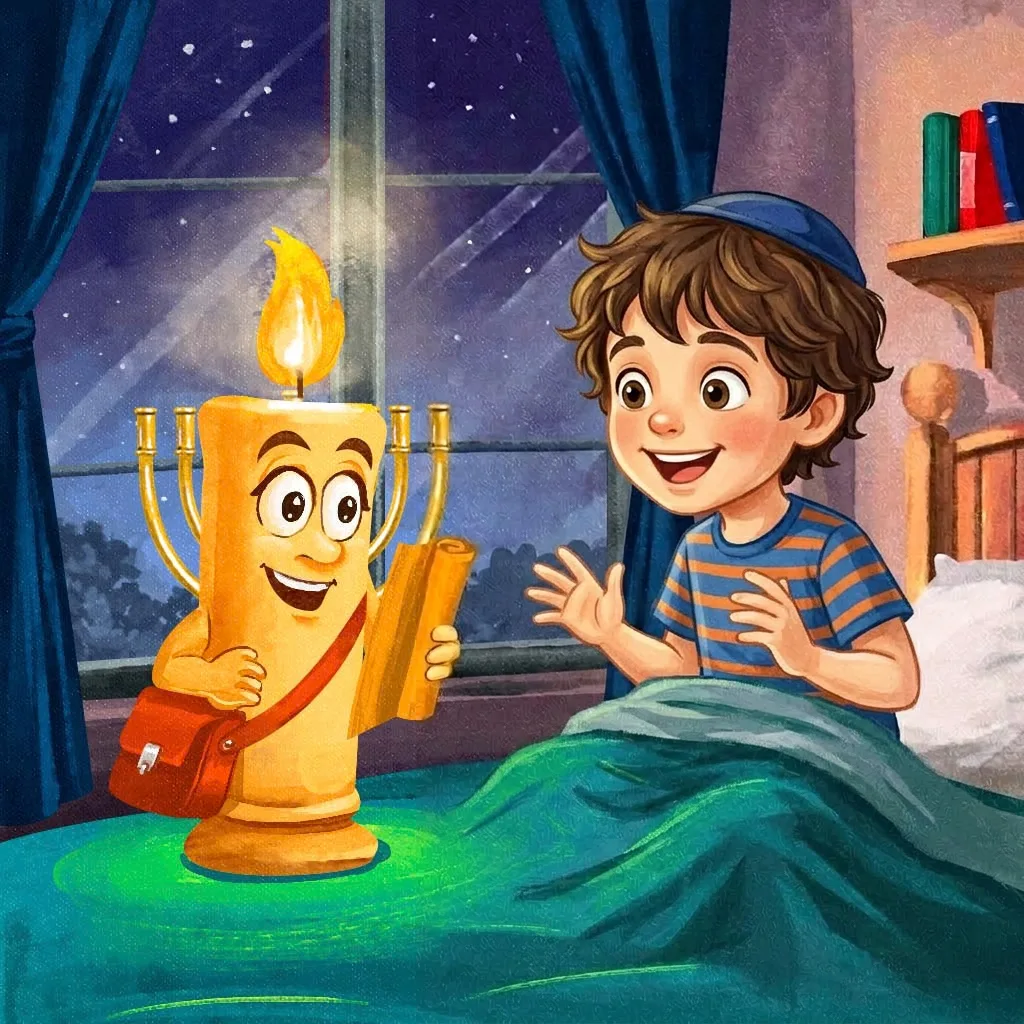
The Lights of Hanukkah is a personalized children's storybook structured so the child character discovers the holiday in real time, alongside the reader. There's no assumed prior knowledge. A helper candle named Shamash shows the way, and one by one they meet Judah (courage), Nes (the miracle), Latke, Gelt, Dreidel, and Or (hope and light). By the end, the child in the story is the first light of Hanukkah that year.
Because your own child's name and photo can appear throughout, it works as a first introduction just as well as it works for a family that's been lighting menorahs for generations. You can preview the whole thing free, which makes it a low-pressure way to bring the holiday into a home — or classroom — that's approaching it for the first time.